
Sometime later this year Australians will vote on the Constitutional enshrinement of a Voice for Indigenous peoples. This is why I think YES is the best response to the referendum question.
Megan Davis, a professor of Constitutional Law at ANU and a Cobble-Cobble woman, spoke in a recent ‘Australian Story’ of her family as an underclass. Her family was Aboriginal, South Pacific Islander, White; not an uncommon blend in Australia. As she’d grown, an appreciation of her mother’s close eye on the family budget established in Megan a clear sense of the importance of government policies and decisions on those who are vulnerable to cost of living and other societal pressures. Megan Davis – who carried around a copy of the Constitution as a 12 year old (now that is uncommon), is a key player in the formulation of the Uluru Statement from the Heart and keen advocate of the YES case in the upcoming referendum.
She’s someone worth listening to.
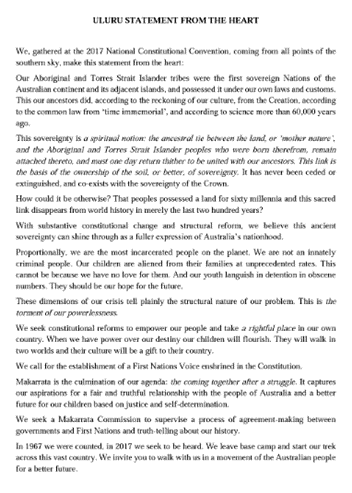
The Uluru Statement from the Heart asks for the establishment of a First Nations Voice in the constitution. The Voice’s key purpose will be the giving of a voice to the First Nations’ peoples – most assuredly an underclass[i] in Australia – so that they might advise government on the impacts of any and all decisions that affect First Nations peoples in a significant way. This constitutional establishment is critical; if simply legislated it can be erased or drowned out by government remit. Inserting it into the CONSTITUTION requires another referendum to potentially remove it; in other words the adult population of Australia must decide, not a government.
YES: What are the key arguments for a VOICE[ii]?
- The voice is the result of years of careful work by Aboriginal and Torres Strait Islanders to find an acceptable and legally sound way to recognise “the First Peoples of Australia” in the constitution.
- It will provide a permanent means of Indigenous community input into the work of the federal parliament and government, with members serving fixed terms to ensure accountability.
- The voices of women and young people will be heard and all parts of the country will be represented.
- It will not have a veto power over decision-making, but inform the making of policies, laws and rules.
- It is best practice to work with communities on practical outcomes rather than impose solutions from Canberra.
And if I can add another reason to vote YES, and perhaps make some use of a modification of a NO argument that ‘there is no place in the constitution for race to be put ahead of need and merit’. Statistically, few would argue that First Nations’ need and merit is a product of their particular history – the socio-economic outcomes of invasion, colonisation, removal from country, social Darwinism, ‘protection’, and so on. A VOICE allows them to express an opinion – as Megan Davis’s mother might see it, regarding the impact of any and all government decisions on them as FIRST NATIONS peoples, Australia’s greatest underclass. Les voix sont la même; the voices are the same via constitutional establishment, no longer the voices of an empty land. This is the gift of THE VOICE, that the voices now become the same; they are given equal – not greater – weight. Gravitas. At least a vocal one.
NO: There are opponents of a YES who are of First Nations peoples, and there are certainly opponents of Yes who are white, but not racist. They will vote NO because they are concerned that:
- There is no place in the constitution for race to be put ahead of need and merit.
- First Nations peoples already have political representation via elections. To establish a VOICE in the Constitution is ‘discriminatory’, even ‘racist’ – it distinguishes one group from another.
- The voice is likely to be made up of activists or people with the money to spend to get elected. The VOICE will not be a genuine reflection of Indigenous Australia’s diversity.
- It is merely symbolic, whereas what are needed are solutions to problems in Indigenous communities in the areas of family violence, housing, education, health and employment.
- A formal treaty should be the first step to reconciliation, rather than a referendum.
- Black sovereignty requires more than a voice, it requires direct involvement in policy-making.
Well – let us debate these.
- Yes, there is a place for race to be put in to the constitution. The omission in the 1901 formulation of the Australian Constitution of INDIGENOUS peoples, and the legacy of the otherness with which FIRST NATIONS people were treated, denied them a place. If they did not count, if they had no VOICE then – we need to fill the VOID. Give them a constitutional VOICE; it’s an act of restitution.
- No – see above. The omission of First Nations’ people from the original CONSTITUTION and the absence of a treaty has already discriminated against them.
- This is a challenge to all democratic systems – where money influences democratic outcomes. There should be checks and balances to counter such.
- It is NOT purely symbolic. If a VOICE is present it will be heard. Not sure how well we’ll listen – but that is another argument.
- The VOICE will no doubt contribute to a better treaty.
- Indeed it does – but a VOICE allows for a wider say in how that sovereignty would work.
UNCERTAIN: And there are still many Australians who are undecided. Such is Arrernte woman, Celeste Liddle. In this Guardian article she clearly outlines[iii] why she finds it hard to vote for a government initiative in which she has no TRUST – perhaps that should be faith. A VOICE perhaps offers more disappointment to an almost endlessly disappointed First Nations peoples.
All I can say to such reasonableness is that I hope in the end you will pin your faith in the years of careful formulation by mostly INDIGENOUS peoples that went into this, and to the Uluru Declaration’s genuine and heartfelt urging that this is a better way than we have ever gone before – and make a decision to vote YES.
[i] To explore a timeline on the fight for rights by Indigenous peoples in Australia see https://www.sbs.com.au/news/article/timeline-indigenous-rights-movement/fb5nvvsdu
[ii] Both the for and against arguments have been drawn from https://www.standard.net.au/story/8134363/key-arguments-for-and-against-the-indigenous-voice/
[iii] Link to the Liddle article: https://www.theguardian.com/commentisfree/2023/jun/26/i-remain-undecided-on-the-indigenous-voice-to-parliament-and-im-exhausted#comment-163278525
 Inkstained fingers